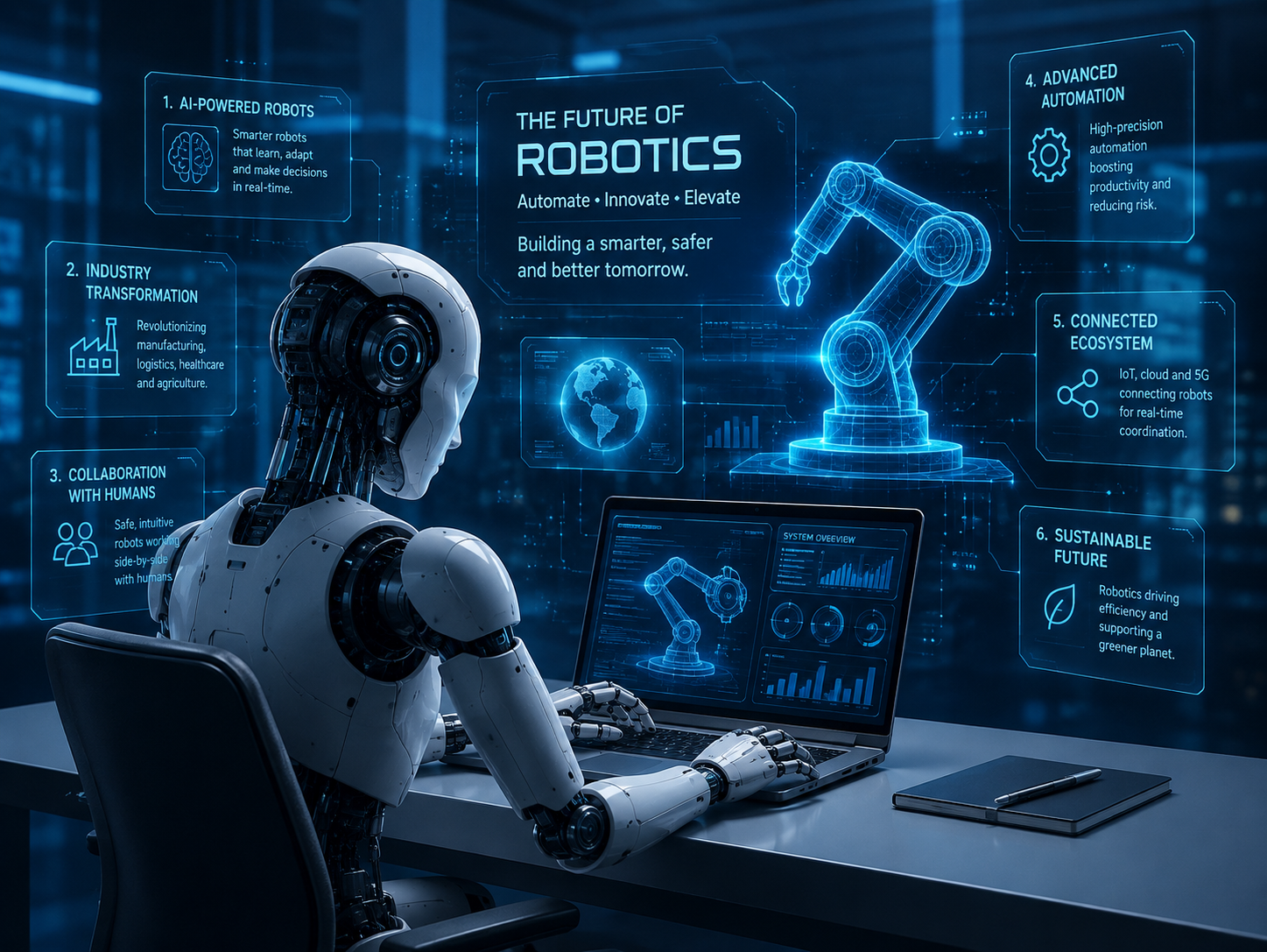
Robotics is no longer a technology limited to factories and research laboratories. Today, robots are becoming smarter, more adaptive, and increasingly capable of working alongside humans. With the rapid development of artificial intelligence, automation, IoT, cloud computing, and advanced sensors, robotics is entering a new era.
The future of robotics is not simply about machines replacing humans. It is about intelligent machines working with people to make industries safer, faster, more efficient, and more innovative.
Here are the key trends shaping the future of robotics.
1. AI-powered robots
The combination of artificial intelligence and robotics is one of the biggest developments in the industry.
Traditional robots generally perform predefined tasks. AI-powered robots, however, can analyze their surroundings, learn from data, adapt to changing situations, and make decisions in real time.
For example, modern robots can use computer vision and machine learning to:
- Recognize objects and environments
- Navigate complex spaces
- Detect problems and anomalies
- Learn from previous operations
- Adapt to changing working conditions
- Make faster decisions
This shift from programmed machines to intelligent machines could fundamentally change how robots are used across industries.
2. Robotics is transforming industries
Robotics is already changing the way businesses operate.
In manufacturing, robots can handle repetitive and highly precise operations. In logistics, autonomous robots can move products through warehouses and distribution centers. Healthcare is using robotics for assistance, precision procedures, rehabilitation, and patient support.
Agriculture is another important area where robotics can make a major difference. Intelligent machines can help monitor crops, identify problems, automate harvesting, and improve resource efficiency.
As robotics technology becomes more affordable and accessible, its impact will expand across:
- Manufacturing
- Healthcare
- Logistics
- Agriculture
- Construction
- Retail
- Transportation
- Defense and space exploration
The result is a gradual transformation from traditional workflows to automated and data-driven operations.
3. Humans and robots will work together
One of the most important ideas about the future of robotics is collaboration rather than replacement.
Collaborative robots, often called cobots, are designed to work safely alongside humans. Instead of completely replacing workers, they can take over repetitive, physically demanding, or dangerous tasks while humans focus on creativity, communication, problem-solving, and decision-making.
Imagine a workplace where:
Humans provide creativity and judgment → Robots provide precision and automation → AI connects the two
This combination could create workplaces that are both more productive and safer.
4. Advanced automation will increase productivity
Automation is becoming increasingly sophisticated.
Modern robotic systems can perform complex operations with extremely high levels of consistency and precision. When combined with AI, sensors, and real-time analytics, these systems can identify inefficiencies and optimize processes continuously.
Advanced automation can help businesses:
- Reduce operational errors
- Increase production speed
- Improve product quality
- Reduce workplace risks
- Lower long-term operational costs
- Operate continuously where appropriate
For businesses, this means robotics is becoming more than a piece of equipment — it is becoming a strategic technology investment.
5. Connected robots and the rise of the robotic ecosystem
The future robot will not necessarily operate alone.
With IoT, cloud computing, 5G, and edge computing, robots can become part of a connected digital ecosystem.
A warehouse, for example, could have hundreds of robots communicating with one another while sharing information with a central system. Managers could monitor performance through dashboards and receive real-time information about productivity, maintenance, and potential problems.
This creates a connected environment where:
Robot + AI + IoT + Cloud + Data = Intelligent Automation
The ability to collect and analyze real-time data will make robotic systems increasingly intelligent and responsive.
6. Robotics and a more sustainable future
Robotics could also contribute to a more sustainable world.
Intelligent automation can help organizations use resources more efficiently by reducing waste, improving energy consumption, optimizing production, and increasing operational precision.
Robotics can support sustainability in areas such as:
- Precision agriculture
- Renewable energy maintenance
- Recycling and waste management
- Energy-efficient manufacturing
- Environmental monitoring
- Automated infrastructure maintenance
As businesses face increasing pressure to reduce their environmental impact, robotics could become an important part of the solution.
What does the future of robotics look like?
The next generation of robotics will likely be more intelligent, autonomous, connected, and human-friendly.
Instead of isolated machines performing repetitive tasks, we are moving toward intelligent robotic ecosystems where machines communicate with each other, understand their environments, learn from data, and collaborate with humans.
The real opportunity isn't simply building robots. It's building smarter systems around robots.
Businesses that begin exploring AI, automation, robotics, and connected technologies today may be better positioned to compete in an increasingly automated economy.
Final thoughts
The future of robotics is already taking shape.
AI-powered robots are becoming smarter. Industries are becoming more automated. Humans and machines are learning to collaborate. Connected technologies are creating robotic ecosystems, while automation is opening new opportunities for productivity and sustainability.
The biggest question is no longer “Will robots become part of our future?” The question is:
“How will we use robotics to build a smarter, safer, and better future?”
And that future is closer than we think.